
THOUSAND YEAR OLD TRADITION -The Water Puppet Show
Photos and Write-up by Coffee Group (Melvin, Kai Zhi, Kerthana, Lexsana, Sinnie and Wei Zhen)

Tradition is a beautiful virtue in our life. No matter what race or heritage you may come from you definitely have your very own traditional culture that exhibits a timeless charm. And such is the charm of Vietnam’s water puppetry that amazes audiences all over the world. This traditional performing art was performed by the farmers thousand of years ago and this performing art has survived the test of time to be hailed as one of Vietnam’s heritage. Traditionally the show was held at a bank of a river, with a screen as the background. And from behind that screen, the puppeteers will control the puppets gliding gracefully on the bank of water accompanied by traditional Vietnamese music. These puppets perform tricks that will take your breath away. This perfect combination of movements, skills and music was originally performed as traditionally source of entertainment for the Vietnamese farmers. The Water Puppet shows were anecdotes of the farmers’ daily life. It is possible that the impact of colonial rule and the Vietnam War, which were significant historical events, were also reflected through the Water Puppet shows.
FAQ - Part 1
FAQ - Part II
EXCLUSIVE INTERVIEW
(A session with the puppeteers)
Question : How long does it take for the members to master this art? And do you think this art will last in Vietnam?
Puppeteers: It all depends on the level of interest and passion you have in this art. The more interest there is, the faster you can master the art. Both the older generation and the younger generation generally takes 5 years to master the skills….. Yes! Of course! It would (last) because the art has been going for a 1000 years already and I still believe that art will last as the younger generation have the ‘interest’ in the art.
Question: What makes this art so interesting?
Puppeteers : The art is unique, in the sense that nobody really knows the method and the tactics used to make the puppet show comes alive and the water puppet show is only show of its kind in the world.
CYCLE OF LIFE – Of a Mangrove Tree
Photos and Write-up by Bamboo group (Mahirah , Hanis , Huda, Liping , Dayang)

It was a fascinating journey for us, exploring Can Gio district mangrove forest. The weather was perfect for us with ample sunshine for us to take a boat ride to and discover further about the mangrove forest. Can Gio mangrove forest is situated in the tropical region of Southern Vietnam. The weather is hot and humid all year round with lots of sunshine and rain. The mangrove area is a mixture of freshwater and saltwater from the sea. The soil is muddy and waterlogged and it is known as the Green of Saigon.

Pencil-like roots, which also known as AERIAL roots. It enables the mangrove tree to take in oxygen during high tide. The tree which has this type of root type is Avicennia.
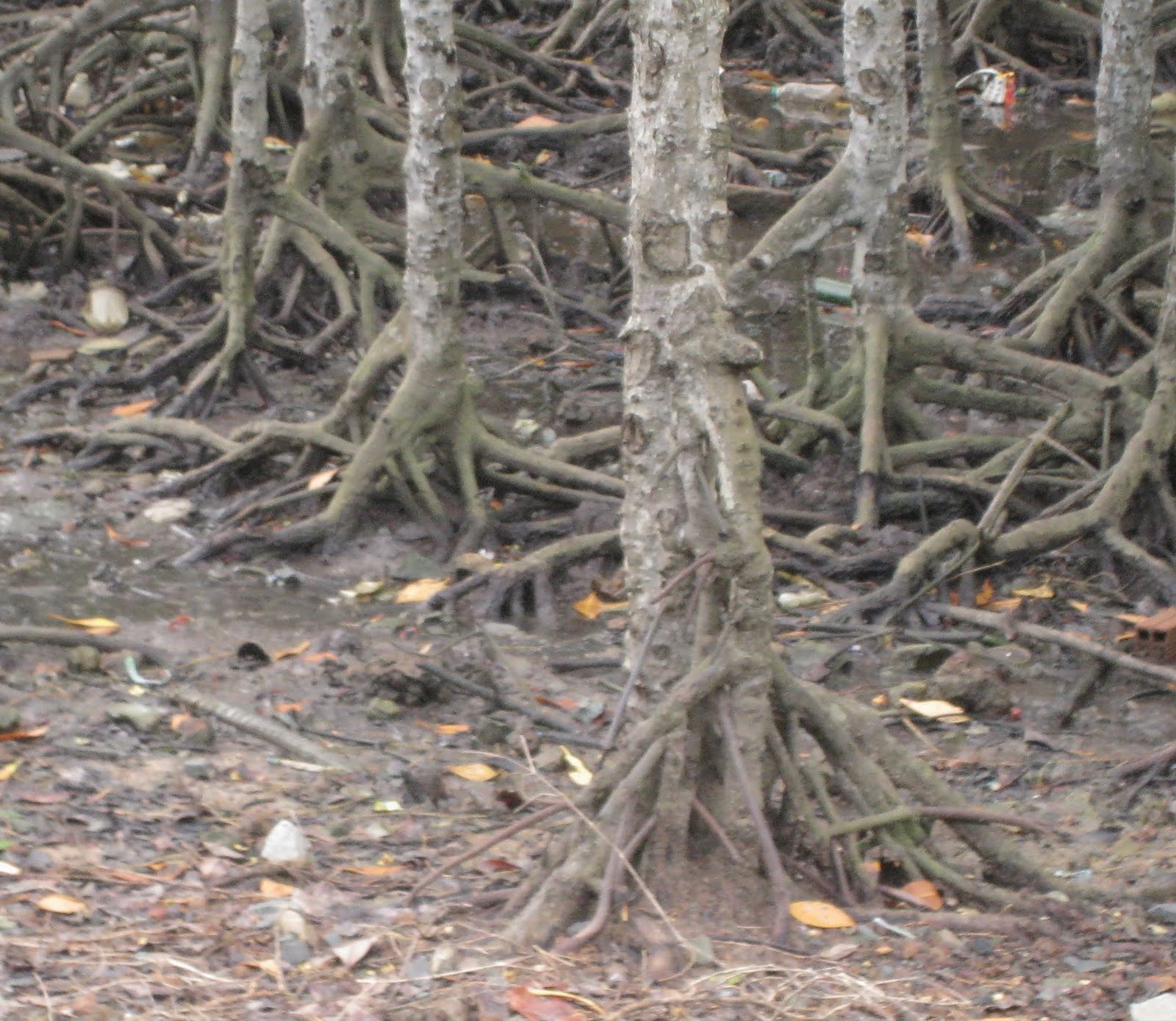
Another roots that I spotted when I was there was the Knobby roots which also known as KNEED roots. The roots will help to support the tree. The tree is Bruguiera

Giant arching roots which is also known as PROP roots. The roots will help to support the trees and prevent it from falling down. These roots will help to reduce coastal erosion as the prop roots will act as buffers to reduce the wave energy. E.g. The Rhizophora


5 STEPS FOR DUMMIES 

Our journey to the mangrove was one of the most enjoyable experiences we ever had. It was a new experience for us to enter the mangrove forest and we found out that the mangrove area in Can Gio covers a huge area. We learnt how important the mangrove forest is in protecting the coastal area from erosion as well as being the ‘Green Lungs’ of Southern Vietnam.

At the end of the Reforestation Program, we are recieved a Certificates of Participation...
on How to plant Mangrove tree - A Reforestation Project
Photos and Write-up by Mangrove group (Sulaiman, Narahj and Andy)


STEP 1
Our group volunteered to show the stages of mangrove reforestation. The
members are me(Sulaiman), Andy and Narahj. We met with the Can Gio people to teach us how to plant mangroves. We collected our boots first and each
person was given a plastic packet containing 20 seedlings.


STEP 2
Next, when we were entered the plantation area, we had to struggle through the
swampy mud. Some of our boots were stuck deep under the mud and we had to
use our strength to get our boots out of the mud. Although it was a tough for us to
walk through it, but with our determination and strong mindset to keep going, we
managed to go to the plantation area.


STEP 3
Upon reaching the plantation area, we had to line up in a straight line as in the photo above. All of us had to plant the mangroves in a straight row so that the mangroves will grow in a straight line. And the distance between one seedling to another seedling is around 60cm. when we plant the seedlings it must be 3cm deep.


STEP 4
When we plant the next seedling we have to move backward so that we know that we are planting in a straight line.


STEP 5
This is how the plantation area looked like before we planted. Beside it, is the aftermath photo of the plantation area! Cool right? We feel blessed that we’ve done something good for the environment. Below is a reflection that we would like to share.
"Man Vs Wild" mangrove
Is forest management successful in Can Gio?
Yes it is successful as the people are willing to look after the mangrove forest. More than 150 families volunteered to look after the mangrove forest. Each family will take care of 1 to 15 hectares of the forest. They are given incentives too. Each family is given 35 US dollar a year. Although the amount of money is not much but they do it with their heart as it is for the GREEN LUNG of SAIGON.
KHAM ON (thank you):D
KHAM ON (thank you):D
HARD TALK - WITH A WAR VETERAN at Rung Sac Guerilla Base
Photos and Write-up by Yellow Star group (Murni, Mardiana, Claire and Ivy)
Interview with the Vietnam War Veteran, Mr Duc - AUDIO Only

To the Guerilla Base Camp
Question: What was the living standard of the marine soldiers during the war?

Mr Duc (War Veteran): The living standard of the marine soldiers was extremely difficult because it is totally isolated and far from the city and according to one of the south resident in Vietnam, anyone in the city or from anywhere provides the soldiers with even one kilo of rice will be killed by the law of the south government. With the patience or love of the people (for the country), because we have to fight the enemy, some of the people take even 12 tonnes of rice from the Mekong delta to this place for the soldiers living here. By doing that, by carrying 12 tonnes of rice by boat they have to camouflage very well. In some of the checkpoints, they had to bribe to go through, they have to give rice or any local product. The people living here have to deal with the mosquito and diarrhea because the water here is not very clean and have to suffer a lot of disease.
Question: How did the marine soldiers get water during the war?

Mr Duc (War Veteran): So basically, they have 3 ways to collect the water. First of all, they collect the water directly from the rain. Another way is they can collect the brackish water from the river. Then they will boil the water. By that way, it’s like making alcohol, water is collect through the steams. And the steam is fresh water and the bottom of the cooker is the salt so that water can be use for drinking and the salt for cooking. But it takes very long to do it that way. By cooking this way, we will only get 30litres of fresh water in 24 hours.
Question: How did the guerilla tactics work?
 Mr Duc (War Veteran): Tthe determination of the marine soldiers led them to victory. and managed to deflect the Americans' offensive and so the Americans concentrated their attacks on this base. Thousand of American soldiers with advanced weapons killed many marine soldiers living in this base. The soldiers hide among the mangrove to carry out guerilla tactics against the Americans. Sometimes the marine soldiers suffered from shortage of food, so they had to eat young plants in the mangrove and catch the fresh crabs to exchange for rice. But the law made by the president of the south Vietnam government demanded the killing of anyone who gave rice to the marine soldiers but the people living right here they had to fight till the last man standing.
Yellow Star Group Reflection :D
Why do we prefer oral history to the written sources?
For oral history we can know the real feelings of the person, the struggle that the person have been through and also can say that its “first hand information” because when the person was interviewed there is no form of restriction to what the person can speak out or what he shared about his feelings, which he shared without any hesitation. Thus, the oral source would be more reliable and trustable because written sources might have higher chances of being vetted by someone and also be changed for propaganda purpose.


